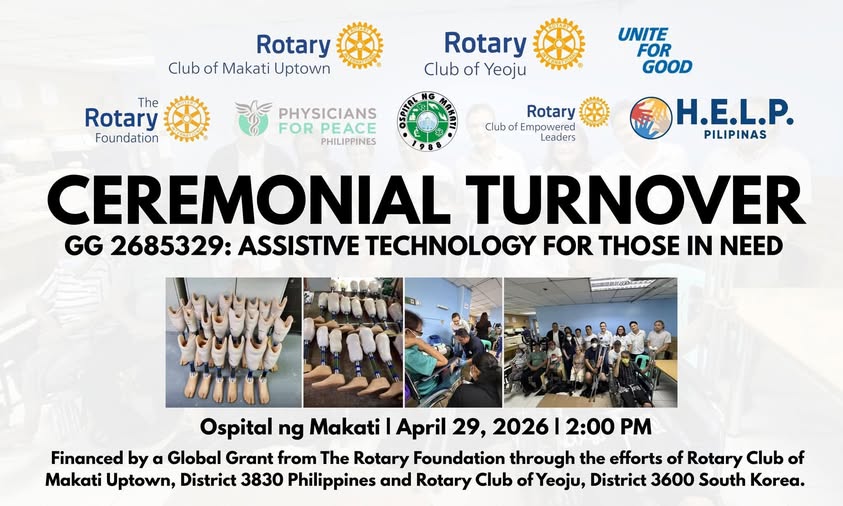
MAKATI CITY – On the afternoon of April 29, 2026, a turnover ceremony took place at Ospital ng Makati. On paper, it was a formal handover, a grant fulfilled, devices delivered, signatures and photographs, and the official launching of a project. But ceremonies like this are never really about the paperwork. They are about what the paperwork makes possible. And what this one made possible was movement, restored to people who had been waiting for it.
The occasion marked the ceremonial turnover of Global Grant GG 2685329, titled “Assistive Technology for Those in Need.” It is a name that is plain almost to the point of understatement. Because behind that clinical phrasing are prosthetic limbs, wheelchairs, and mobility devices, and behind each of those is a person whose world is about to grow larger.
A Grant That Crossed an Ocean
What makes this project remarkable is the distance its goodwill traveled. The grant was financed through The Rotary Foundation, made possible by the combined efforts of the Rotary Club of Makati Uptown, District 3830 in the Philippines, and the Rotary Club of Yeoju, District 3600 in South Korea.
Consider that for a moment. A club in South Korea and a club in the Philippines, separated by seas and languages and the ordinary business of their own communities, looked at the same need and decided, together, to meet it. That is the quiet machinery of Rotary at its best, the way it turns geographic distance into no distance at all when there is good to be done. The Filipinos who received these devices may never meet the members in Yeoju who helped fund them. But they are connected now, bound by an act of generosity that asked for nothing in return.
The Hands That Carried It
A grant is only a promise until people on the ground turn it into something real. This one passed through many careful hands before it reached the people it was meant for.
Physicians for Peace Philippines brought its mobility expertise to the effort, the clinical knowledge and patient care that ensure a prosthesis or wheelchair is not merely handed over but properly fitted, matched to the body and the life it will serve. Ospital ng Makati opened its doors as host and partner, grounding the project in a place of healing. The Church of Jesus Christ of Latter-day Saints lent its longstanding support to mobility provision, a commitment that has helped restore movement to so many across the country.
And alongside them stood the wider Rotary family and its partners, including the Rotary Club of Empowered Leaders and H.E.L.P. Pilipinas, each contributing to the network of effort that a project like this requires. No single one of these groups could have done this alone. Together, much was done.
Why Mobility Matters
It is easy to underestimate what the loss of mobility takes from a person. It is not only the limb or the use of the legs. It is the independence that goes with them. The ability to work, to earn, to move through one’s own home without help. The dignity of crossing a room unassisted. The simple, enormous freedom of going where you wish, when you wish.
When that is taken away, the world contracts. And when it is restored, the world opens again. This is why PFPP’s mobility program exists, and why work like this is, in the words of those who carry it out, work worth doing. A prosthetic limb is not a gift of plastic and steel. It is a gift of a future. A wheelchair is not a piece of equipment. It is a door swinging open onto a life that had been put on hold.
What the Ceremony Really Marked
When the speeches ended, and the devices were turned over, the ceremony at Ospital ng Makati closed the way these things do, with gratitude. Thanks to Rotary. Thanks to Ospital ng Makati. Thanks to The Church of Jesus Christ of Latter-day Saints. Thanks to the many people, named and unnamed, who each played a part in making this grant possible.
But the real measure of this day will not be found in the ceremony itself. It will be found in the weeks and months that follow, in a person taking steps they thought were behind them, in someone moving through their neighborhood under their own power, in a life quietly returned to its owner. That is what was really turned over on April 29. Not just devices, but possibility.
Physicians for Peace Philippines continues its commitment to restoring mobility, dignity, and independence to underserved communities across the country. To partner, donate, or volunteer, visit physiciansforpeace.ph.